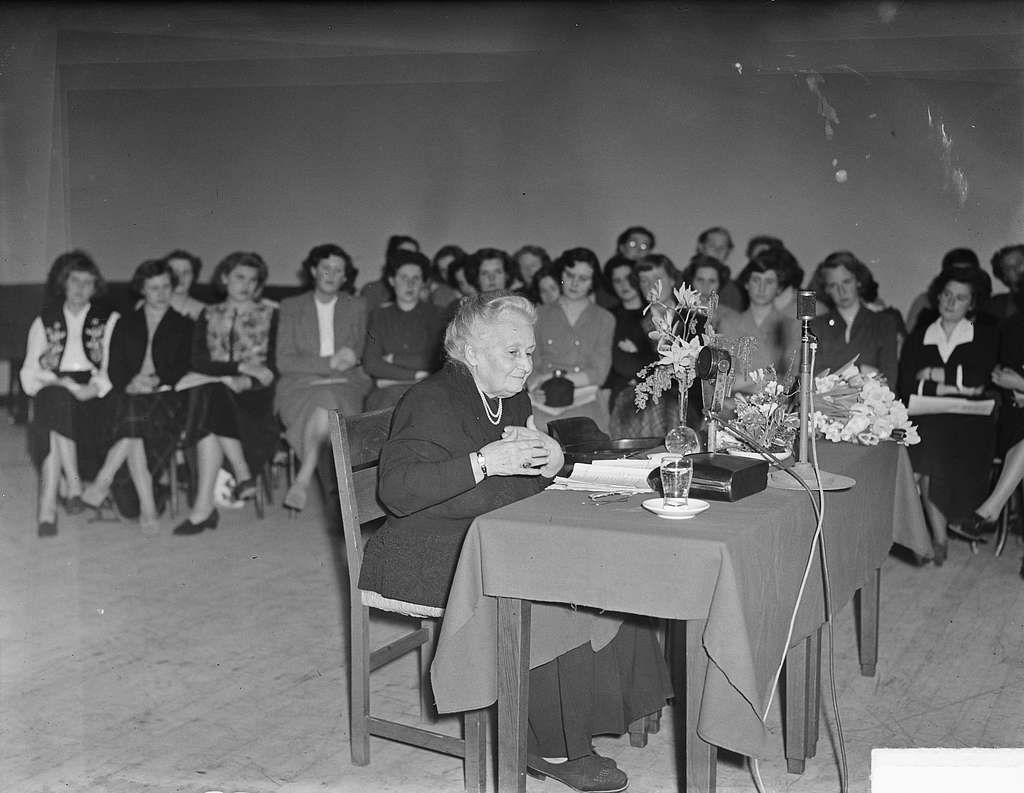
Maria Montessori changed education forever. In 1907, working with the poorest children in Rome, she discovered something that would upend a century of conventional schooling: when you trust learners, follow their curiosity, and personalize the environment around their needs, they don't just survive — they thrive. Her Casa dei Bambini ("Children's House") produced results so dramatic that educators and scientists traveled from around the world to see it with their own eyes.
Today, more than 4,000 Montessori schools operate in the United States alone. Her philosophy has shaped early childhood education across the globe, validated repeatedly by modern cognitive science. And yet, a strange gap has persisted for over a century: there is no Montessori university.
Elton University is changing that.
A Philosophy That Never Made It to Campus
The first Montessori school in the United States opened in 1911 at the Edward Harden Mansion in Sleepy Hollow, New York. The movement spread — and then, for decades, stalled. It wasn't until 1975 that Cincinnati established the first public Montessori classroom in the U.S., at the former Mt. Adams Elementary School, kicking off a wave of public Montessori magnet programs that continues today.
But by 1975, higher education was a locked room.
The Higher Education Act of 1965 made accreditation a prerequisite for federal grants and loans. Pell Grants came under these rules in 1973. What began as a quality-assurance mechanism gradually hardened into something else entirely: a system that researchers have described as an oligopoly or "cold cartel," one that explains the gradually falling quality and precipitously rising costs of higher education over the last seventy years. The accreditation system, which began as a voluntary process in the 19th century, became a de facto requirement — and in doing so, created significant barriers to entry for innovative start-ups in higher education, while functioning as a poor gauge of actual program quality.
The result? Among new colleges, religious, for-profit, and public institutions have started at roughly 5 times the rate of private, secular, nonprofit ones. The educators most likely to build something like a Montessori university — idealistic, mission-driven, non-commercial — were precisely those most shut out by the gatekeeping system.
Montessori's philosophy arrived at the doorstep of higher education and found no one willing to open the door.
What a Montessori University Would Look Like
To understand what Elton is building, it helps to return to what Montessori actually believed.
At the core of her method is a radical form of respect: respect for the learner as the agent of their own education. In a Montessori environment, teachers don't deliver content to passive recipients — they observe, guide, and respond. The learner drives. The environment is designed to meet the learner where they are, not where a bureaucratic curriculum expects them to be. Intrinsic motivation, personal interest, self-pacing, and mastery before advancement — these are the pillars.
Now look at Elton. Students design their own learning plans with dedicated professors and coaches. There are no rigid semesters, no one-size-fits-all curricula, no 300-person lecture halls. Every student works in one-on-one or small group sessions with faculty who have real-world expertise in their field. Learning is project-based, interest-driven, and tied explicitly to each student's professional goals. Progress happens at the learner's pace.
That's not an accident. It's Montessori — applied to adult learners and operationalized for the demands of 21st-century higher education.
Montessori Intuited What Science Later Confirmed
Here's what makes Montessori so remarkable in retrospect: she developed her approach through observation and iteration in the early 1900s, long before the cognitive and educational sciences had the tools to explain why it worked. But work it did — and modern research has caught up.
On personalized learning: Research reviews consistently show predominantly positive impacts of personalized learning across key dimensions including academic performance, student engagement, learning behaviors, cognitive development, and motivation.
On intrinsic motivation: Self-Determination Theory, one of the most robust frameworks in educational psychology, holds that learners who pursue goals from genuine interest and internal drive outperform those who respond to external pressure. The evidence base here spans decades and multiple continents.
On one-on-one tutoring: In 1984, educational psychologist Benjamin Bloom published one of the most cited findings in the history of education science. The average student tutored one-to-one using mastery learning techniques performed two standard deviations better than students educated in a classroom environment — meaning the average tutored student outperformed 98% of students in the conventional control class. Bloom called this the "2 Sigma Problem" — not because tutoring didn't work, but because it worked so well that the challenge became how to bring that quality to more people at scale.
Elton's answer to Bloom's 2 Sigma Problem is the same answer Oxford developed centuries ago: make one-on-one tutoring the core model, and make it financially viable through a nonprofit structure, a lean operation, and a mission-driven approach that invests in people rather than buildings.
On Montessori's outcomes specifically: A rigorous 2023 meta-analysis reviewed Montessori research and found that Montessori education produces more positive results for general academic ability in math and language, inner experience of school, executive function, and creativity. A second meta-analysis found Montessori more effective in developing cognitive abilities, social skills, creativity, motor skills, and academic achievement. And the effects don't stop at childhood: a 2021 study published in Frontiers in Psychology found an association between Montessori education in childhood and higher adult wellbeing — suggesting that a pedagogy built on self-determination, meaningful activities, and social stability produces benefits that last a lifetime.
Maria Montessori didn't just build a better classroom. She intuited a model of human development that science spent the next hundred years confirming.
Why We're Building This Now
Elton University is a 501(c)(3) nonprofit. We exist not to extract tuition revenue, but to provide the highest possible quality of education to anyone who seeks it. We believe that the crisis in higher education — rising costs, falling outcomes, collapsing trust — stems directly from a system that locked out innovators and protected incumbents for decades.
We also believe that the solution isn't to tear down what works. Oxford's tutorial model works. Montessori's principles work. Evidence-based learning science works. The task is to integrate them into something new: a university that takes adult learners seriously, personalizes their education, connects it to their real goals, and delivers world-class outcomes at a price that doesn't require a lifetime of debt.
That's what we're building. And we think Maria Montessori — who spent her life fighting educational establishments that told her she was wrong, only to be vindicated by the evidence — would recognize the spirit of it.
There has never been a Montessori university.
There is now.
Interested in learning more about Elton University's approach? See how Elton's self-directed bachelor's works for Montessori students, schedule a free info session or apply today.