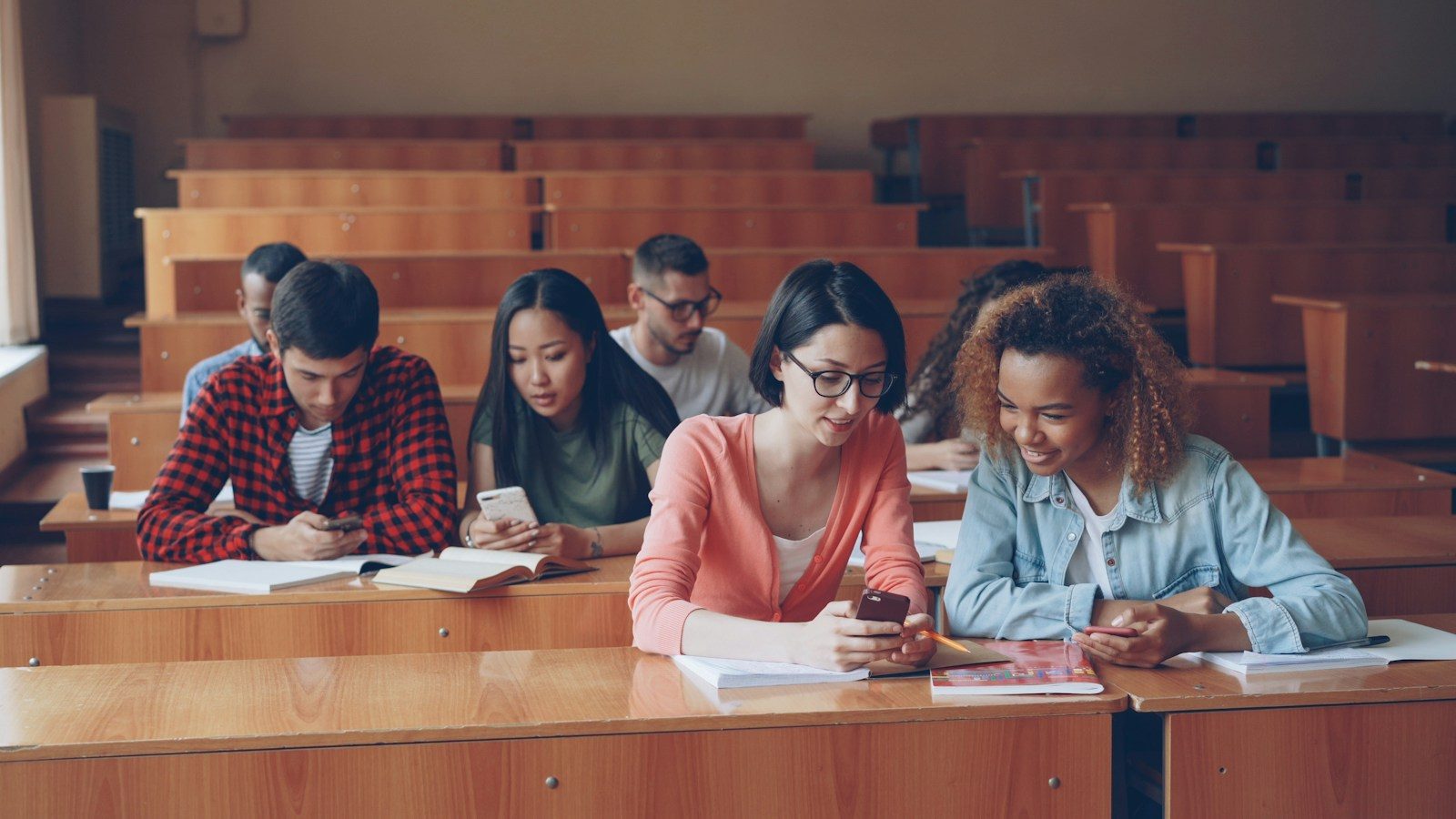
American schools spent roughly $30 billion on education technology in 2024—ten times what they spent on textbooks the same year. The goal was noble: modernize instruction, close equity gaps, prepare students for a digital future.
What happened instead is now making its way through congressional testimony, international research, and the quiet policy reversals of school districts from Kansas to North Carolina that would rather not talk about how much they spent on devices now sitting in carts at the back of classrooms.
In January 2025, neuroscientist Jared Cooney Horvath sat before the U.S. Senate Committee on Commerce, Science, and Transportation and said what the ed-tech industry had spent years hoping no one would say under oath: Gen Z is the first generation in modern history to score lower than their parents on numeracy, literacy, and creativity.
The $30 billion screen experiment failed. And the science explains exactly why.
Screens Train Brains to Skim, Not Think
When you read on a screen, your brain shifts into a different gear. Norwegian researchers, leading an ongoing study across 30 countries, found that screen-based reading replaces deep comprehension with shallow skimming—readers scan for keywords and believe they are absorbing the material when in fact they are not.
A 2024 meta-analysis of 49 studies confirmed this with hard numbers: students who read on paper consistently score higher on comprehension tests than those who read the same material on screens. Researchers call this the "screen inferiority effect." A separate 2023 meta-analysis of 470,000 participants across more than three dozen countries, led by researchers at the University of Valencia, found that print reading correlates more strongly with reading comprehension than digital reading at every age group studied.
For younger readers, the gap is staggering. Researchers estimate that children who spend ten hours reading print books exhibit six to eight times higher reading comprehension than children who spend the same time reading digitally.
Six to eight times. That is not a marginal effect. That is a different outcome entirely.
Your Brain on a Pen
The story gets more striking when you look at how students take notes.
A 2025 neuroimaging study published in a peer-reviewed journal synthesized findings from 63 studies on handwriting versus typing. The conclusion: handwriting activates a broader network of brain regions—motor cortex, visuospatial integration areas, sensory processing, and memory circuits. Typing engages far fewer neural circuits, producing a more passive cognitive experience.
Why does that matter? Because learning is the act of forming connections. When you write by hand, you cannot transcribe fast enough to copy verbatim, so your brain must listen, compress, paraphrase, and reconstruct—all forms of active processing that build memory. Typists, by contrast, tend toward verbatim transcription: their fingers race to capture words while their minds sit largely idle.
A 2022 meta-analysis found that university students who take handwritten notes perform better on subsequent assessments than those who type—and the advantage compounds when students review their notes before the exam. A 2024 study in Scientific American reached the same conclusion: handwriting activates more brain areas, and the slower pace forces learners to summarize and reflect, deepening understanding.
A 2024 study published in the International Journal of Instruction found that students who organized their handwritten notes with highlights and clear structure performed better on memory tasks and achieved higher GPAs than their typing peers.
The pencil, it turns out, is mightier than the keyboard.
The World Is Reversing Course
Other countries read the same research and acted faster.
Sweden—one of the first nations to replace textbooks with screens, back in 2009—is now investing to return paper textbooks to every student after concluding that attention spans shortened and learning did not improve. France, Italy, the Netherlands, and China have introduced nationwide device restrictions in schools. South Korea passed a law in 2025 banning phones and smart devices during class hours entirely.
UNESCO reports that by the end of 2024, about 79 education systems—roughly 40% of countries worldwide—had laws or policies restricting smartphone use in schools, up from 30% just a year earlier. New York enacted a bell-to-bell phone ban as part of its FY2026 state budget.
The shift is not anti-technology. It is pro-learning.
The Real Gold Standard: A Human Being Who Knows You
Here is the most important finding in all of educational research, and it predates the screen debate by four decades.
In 1984, educational psychologist Benjamin Bloom published what became one of the most cited findings in the history of education: his "2 Sigma Problem." Bloom compared three learning conditions—conventional classroom instruction, mastery learning, and one-on-one tutoring. The results were stark. The average student tutored one-on-one outperformed 98% of students in conventional classrooms. Two full standard deviations of improvement. In practical terms, the average C student became an A student. The average D student became a B student.
Bloom called this finding the "2 Sigma Problem" because the gain was so large—and seemingly so impossible to scale—that he challenged the entire research community to find group instruction methods that could match it.
No one has fully solved Bloom's challenge. But Elton University has made it the center of its model.
What Elton Does Differently
We will be honest: Elton is not a screen-free university. We use Slack, Zoom, email, and digital tools because they connect students and professors across the world and make our model financially accessible. That is a real and important advantage.
But Elton made two foundational commitments that put it on the right side of the science—commitments that most universities, digital or otherwise, have not made.
First: every student learns one-on-one with a human expert.
Elton's core instructional method is direct, personal tutoring with professors who bring real-world expertise and genuine passion for teaching. This is not an AI tutor. It is not a chatbot with a syllabus. It is a human being who listens, adapts, challenges, and encourages—every session, for every student. Bloom's 2 Sigma research tells us this is the single most powerful learning intervention ever documented in education science.
Second: Elton assigns books.
A lot of them. Real books, read with care. Every Elton program builds reading deeply into the learning plan because the research on print comprehension is unambiguous: reading physical books builds the kind of deep, durable understanding that screen-based skimming cannot replicate. When your professor asks you to read something, they expect you to sit with it, annotate it, and come to your next session ready to think about it together.
This is not nostalgia. This is evidence-based pedagogy.
The Honest Tension
We are not suggesting universities should be Luddite monasteries with typewriters and candlelight. Technology is a tool, and tools matter. The failure of the $30 billion screen experiment was not technology per se—it was the naive assumption that replacing human instruction with screens would improve learning. It did the opposite.
The research points toward a clear principle: screens are productivity tools, not learning engines. Use them to connect, communicate, organize, and ship work. But for the actual act of learning—reading, thinking, remembering, understanding—human attention, physical books, and a pen in hand remain the gold standard.
Elton's model was built around this distinction from day one.
Learning That Actually Works
If you are choosing a university—or advising someone who is—the question to ask is not "how much technology does this program use?" The question is: "How will I actually learn here?"
Will someone who knows their field and cares about your success sit with you, challenge your thinking, and help you grow? Will you read deeply and widely? Will your education treat you as a mind to develop, not a passive consumer of content?
At Elton, the answer to all three questions is yes.
The science has always pointed here. We just built the university to match it.
Ready to learn the way your brain was built to learn? Schedule a free info session with Elton University →
Sources:
- Bloom, B.S. (1984). "The 2 Sigma Problem: The Search for Methods of Group Instruction as Effective as One-to-One Tutoring." Educational Researcher.
- Altamura, L., Vargas, C., & Salmerón, L. (2023). Meta-analysis on digital vs. print reading comprehension, University of Valencia (470,000+ participants).
- Marano, N. et al. (2025). "The Neuroscience Behind Writing: Handwriting vs. Typing." PMC/MDPI.
- 2024 meta-analysis of 49 studies on screen vs. paper reading comprehension (screen inferiority effect).
- Scientific American (2024). "Why Writing by Hand Is Better for Memory and Learning."
- Voyer, D., Ronis, S.T., & Byers, N. (2022). "The effect of notetaking method on academic performance: A systematic review and meta-analysis."
- Crumb, R.M., Hildebrandt, R., & Sutton, T.M. (2022). "The value of handwritten notes." Teaching of Psychology.
- UNESCO (2024). Global Education Monitoring Report on smartphone bans in schools.
- U.S. Senate Committee on Commerce, Science, and Transportation testimony by Jared Cooney Horvath (January 2025).