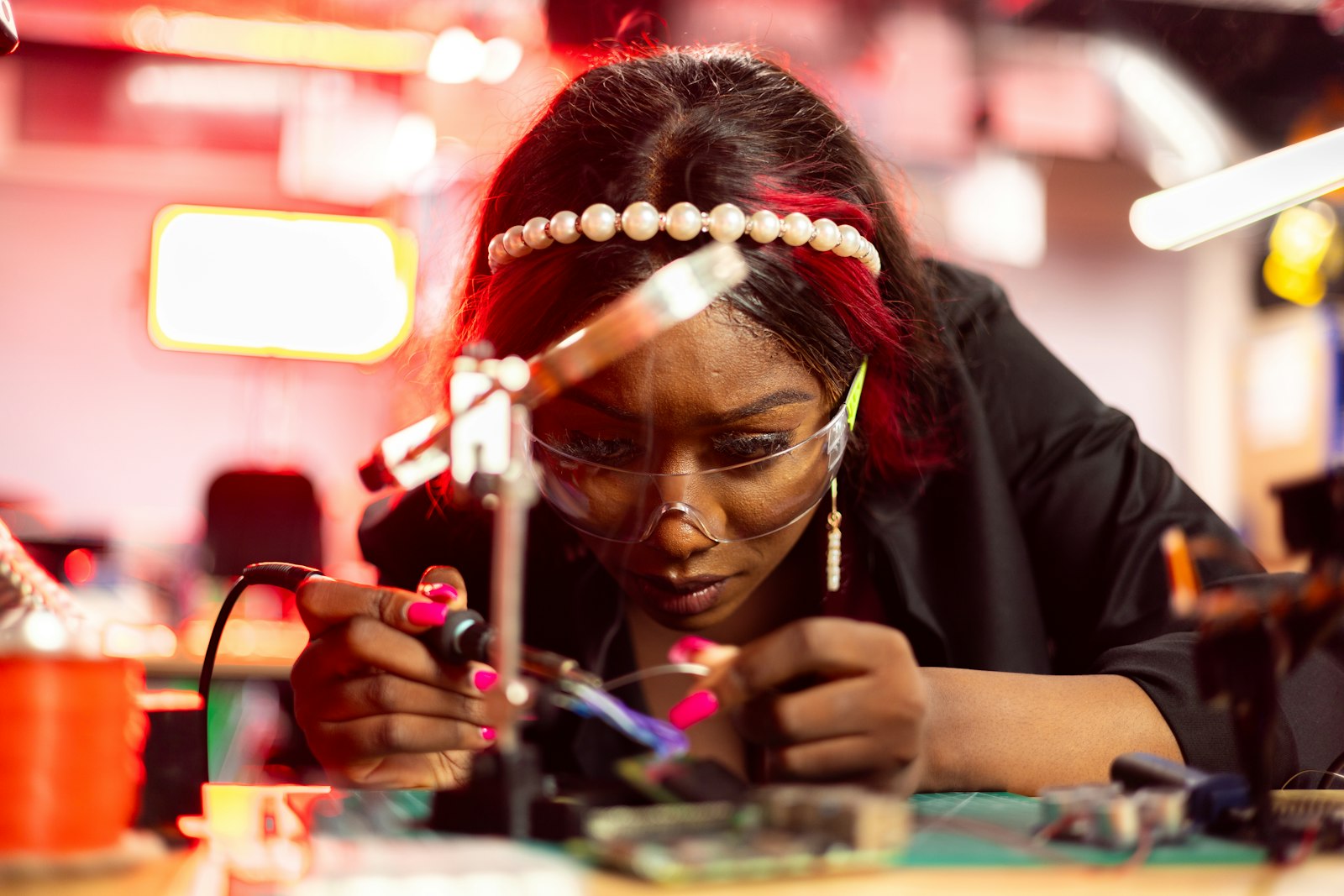
We tend to treat the years between 18 and 25 as a waiting room. Finish your requirements. Get your degree. Get some experience. Then you can start doing serious work.
History disagrees. Some of the most important discoveries, inventions, and works of art in human history were made by people who were 25 or younger, and many of them did that work largely on their own, outside of any formal program.
Here are twelve of them, and what their stories tell us about how great work actually happens.
The Scientists and Mathematicians
Isaac Newton, age 22–23 (1665–1666). When the Great Plague closed Cambridge, the young Newton went home to his family's farm in Woolsthorpe. Working alone for about eighteen months, he laid the foundations of calculus, made his breakthrough experiments on light and color, and began working out the theory of gravitation. Historians call it his annus mirabilis, his "miracle year." No professor assigned any of it.
Albert Einstein, age 16 (1895–1896). As a teenager, Einstein imagined what it would be like to chase a beam of light and ride alongside it. The puzzle stayed with him for a decade. In 1905, at 26, working not as a professor but as a clerk at the Swiss patent office, he published the theory of special relativity. The question that led there started when he was 16.
Blaise Pascal, age 19 (1642). To help his father, a tax official buried in calculations, Pascal began designing a machine that could add and subtract. The Pascaline was one of the first mechanical calculators ever built.
Évariste Galois, ages 17–20 (1829–1832). Galois worked out the ideas that became group theory, now a foundation of modern algebra, as a teenager, mostly on his own. His papers were lost, misunderstood, or rejected by the leading mathematicians of his day. He died after a duel at 20, and the importance of his work wasn't recognized until more than a decade later.
Srinivasa Ramanujan, before age 25 (1900s–1913). Largely self-taught and working as a clerk in Madras, Ramanujan filled notebooks with thousands of original results in number theory and analysis. In 1913, at 25, he wrote to the Cambridge mathematician G. H. Hardy. Hardy recognized his genius, and the collaboration that followed transformed mathematics.
The Inventors
William Henry Perkin, age 18 (1856). During his Easter vacation, in a makeshift lab in his family's home, the teenage Perkin was trying to synthesize quinine, a malaria treatment. He failed, and instead produced a brilliant purple compound: mauveine, the first synthetic dye. It launched the synthetic dye industry and much of modern industrial chemistry.
Philo Farnsworth, age 21 (1927). As a 14-year-old plowing a field in Idaho, Farnsworth realized that an image could be scanned line by line, just like the rows he was plowing. At 21 he used that idea to transmit the first image by all-electronic television.
The Artists and Writers
Mary Shelley, age 18 (1816). During a cold, stormy summer at Lake Geneva, Lord Byron challenged his guests to write ghost stories. Shelley began what became Frankenstein, published when she was 20. Many consider it the first work of science fiction.
Gian Lorenzo Bernini, age 23 (1621–1622). Bernini carved The Rape of Proserpina, in which marble seems to give way like soft flesh under a hand. It's still considered one of the greatest sculptures ever made.
Wolfgang Amadeus Mozart, age 21 (1777). Mozart was famously a child prodigy, but many musicologists point to his Piano Concerto No. 9 (often called the "Jeunehomme," and now known as the "Jenamy" after the pianist it was written for) as the work where his mature genius first fully emerged.
The Founders
Enzo Ferrari, age 21 (1919). Ferrari began racing professionally at 21. The company that bears his name came decades later, but the obsession, and the knowledge he built on the track, began then.
Michael Dell, age 19 (1984). As a freshman at the University of Texas, Dell began building and selling custom computers out of his dorm room. That side business became Dell Inc.
What They Had in Common
Look closely at these stories, and a few patterns stand out.
They followed their own questions. Newton, Einstein, Ramanujan, and Farnsworth weren't completing assignments. They were chasing problems that fascinated them, sometimes for years. Their best work came from curiosity, not requirements.
They worked independently, often outside institutions. Newton did his greatest work at home, not at the university. Perkin worked in a home lab during vacation. Einstein published while working at a patent office. Ramanujan worked as a clerk. Dell built his business in a dorm room, not a classroom.
They made real things. A calculator. A dye. A sculpture. A novel. A television. Their learning wasn't preparation for some future moment when they'd finally be allowed to contribute. The work was the learning.
Most had a mentor or patron in their corner. This is the part of the story that's easy to miss. Bernini had his father, a sculptor, and the patronage of Cardinal Scipione Borghese. Mozart had his father, Leopold. Perkin had studied under the chemist August Wilhelm von Hofmann. Farnsworth shared his television idea with his high school chemistry teacher, Justin Tolman, who encouraged him (and whose testimony later helped Farnsworth win a patent fight). Ramanujan's life changed when Hardy answered his letter.
And then there's Galois. Brilliant, independent, and on his own, with no one in a position of influence who understood his work or championed it. His ideas survived, but he didn't live to see them recognized. His story is a reminder that independence alone isn't enough. Young people doing serious work also need someone who takes them seriously.
Why Traditional College Gets This Backward
The modern university asks talented 18-year-olds to spend their first two years on general education requirements, sitting in lectures, following a sequence set by someone else. Original work, if it comes at all, is saved for the very end, or for graduate school, or for "later."
But the stories above suggest that the years between 16 and 25 aren't a waiting room. For many people, they're the most creative, energetic, and fearless years they'll ever have. A system that spends those years on prerequisites may be wasting the very thing it's supposed to develop.
What Elton Is Built to Do
Elton University's mission is to support exactly this kind of work: young people pursuing their own questions, making real things, and doing it with an expert in their corner.
That's why our student-centered bachelor's degree works the way it does:
- No prerequisites and no general education checklist. You start on the questions and projects that matter to you, from day one.
- Learning tracked in Dashes. Instead of traditional courses, learning at Elton is tracked in Dashes: bursts of curiosity, hard work, and study lasting a day to a month. Follow a question as far as it goes, or change direction tomorrow.
- 1-on-1 with human experts. Instruction is with a professor who knows you and your work, 1-on-1 or in a very small group. In other words: the mentor that Bernini, Perkin, and Ramanujan had, and that Galois never found.
- Dual enrollment for younger students. Dual enrollment is available for advanced high schoolers and students under 18, so you don't have to wait to start.
- Real work counts. Research, art, inventions, and businesses aren't extracurriculars at Elton. They're your education.
And for researchers ready to go further, our PhD by publication lets you earn a doctorate through your own peer-reviewed research, at your own pace, wherever you are.
The next Newton, Shelley, or Farnsworth is out there right now, probably 17 or 19 or 22 years old, and probably being told to wait. We'd rather help them start. If that sounds like you, let's talk.