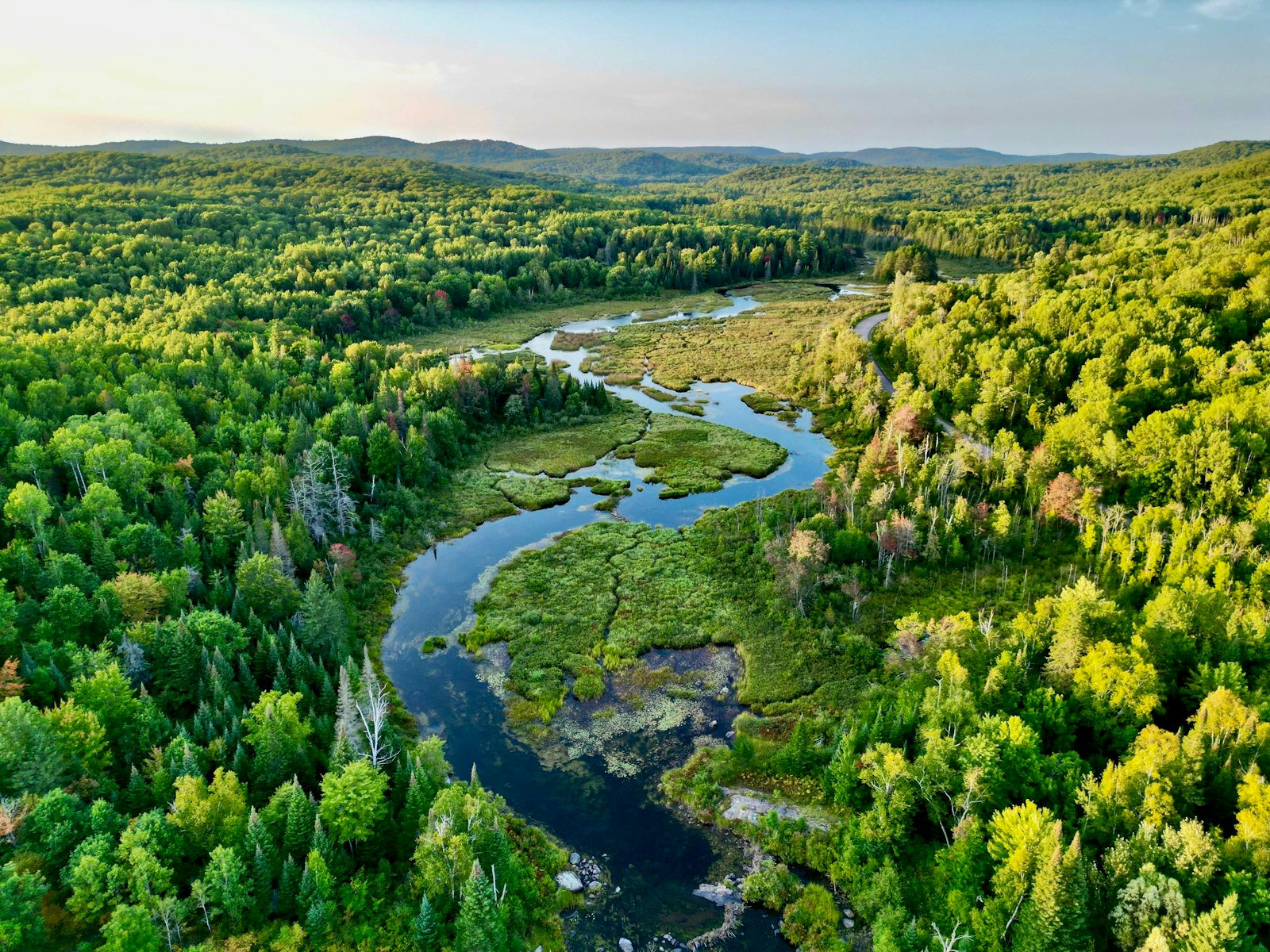
Most economics textbooks draw the economy as a circle: money flows from households to firms and back again. Ecological economists ask a simple question about that diagram. Where do the materials and energy come from, and where does the waste go?
Ecological economics is the field that treats the economy as part of the biosphere, a system that takes in energy and raw materials, turns them into goods and services, and gives off waste and heat. It's one of the fastest-growing heterodox economics traditions, and its questions are now at the center of debates about climate, growth, and wellbeing.
Ecological vs. Environmental Economics
The two sound alike, and they overlap, but they start from different places.
| Environmental economics | Ecological economics | |
|---|---|---|
| Tradition | Branch of mainstream economics | Interdisciplinary, heterodox field |
| Starting point | Pollution as a market failure (an "externality") | The economy as a subsystem of a finite planet |
| Main tools | Carbon taxes, cap-and-trade, cost-benefit analysis | Biophysical limits, material and energy flows, plus policy |
| Nature and capital | Largely substitutable | Many natural systems have no substitute |
| Growth | Can be made green | Questions whether endless growth is possible or desirable |
Many ecological economists use environmental economics tools too. The difference is about framing: is the environment one sector the economy affects, or the foundation the whole economy rests on?
Where Ecological Economics Comes From
- Kenneth Boulding's 1966 essay "The Economics of the Coming Spaceship Earth" contrasted a "cowboy economy" of endless frontiers with a "spaceman economy" that must recycle everything.
- Nicholas Georgescu-Roegen's The Entropy Law and the Economic Process (1971) applied the laws of thermodynamics to economics: every economic process degrades usable energy and materials.
- The 1972 report The Limits to Growth modeled what would happen if population and production kept growing on a finite planet.
- Herman Daly, a student of Georgescu-Roegen, developed the idea of a steady-state economy and spent several years at the World Bank.
- The International Society for Ecological Economics was founded in 1988, and the journal Ecological Economics followed in 1989.
Key Ideas in Ecological Economics
Scale
Daly argued that economics has three questions, not two: efficient allocation, fair distribution, and sustainable scale. Markets can help with the first, but they can't tell you how big the economy should be relative to the ecosystems that support it.
Strong sustainability
Mainstream economics often assumes that natural capital, like forests or fisheries, can be replaced by human-made capital, like machines or money. Ecological economists argue that some natural systems, such as a stable climate or healthy soils, have no substitute, so they must be protected directly.
Steady-state economics
A steady-state economy keeps its throughput of materials and energy roughly constant and within ecological limits, while still allowing improvements in quality, technology, and wellbeing.
Degrowth
A newer movement, associated with writers such as Serge Latouche, Giorgos Kallis, and Jason Hickel, argues that wealthy countries should deliberately scale down material and energy use, while protecting wellbeing through public services, shorter working hours, and fairer distribution. Critics, including many "green growth" advocates, argue that clean technology can decouple growth from emissions fast enough. That debate is one of the liveliest in economics today.
Beyond GDP
GDP counts the value of market activity, but not the depletion of natural resources, unpaid care work, or wellbeing. Ecological economists have helped develop alternatives such as the Genuine Progress Indicator, and Kate Raworth's Doughnut Economics proposes a "safe and just space" between a social foundation of human needs and an ecological ceiling of planetary boundaries.
Why Study Ecological Economics?
Climate change, biodiversity loss, energy transitions, and resource security are now central questions for governments, businesses, and communities. Ecological economics gives you tools to analyze them: energy and material accounting, systems thinking, and policy design, along with a framework for thinking about what kind of prosperity can last.
It also connects naturally with other traditions. Georgist economists study land and natural resource rents; Post-Keynesians study how to finance a green transition; feminist economists study care and wellbeing; and mainstream environmental economists bring powerful tools for pricing pollution.
How to Study Ecological Economics
Start with Daly's Beyond Growth and Raworth's Doughnut Economics, then read Georgescu-Roegen for the deep theory and Kallis or Hickel alongside green-growth critics for the current debate.
At Elton University, you can study ecological, environmental, and resource economics side by side in a heterodox economics master's, 1-on-1 with professors who know each field well. You'll build a portfolio of research on the climate and resource questions you care about most, from local energy policy to global development, while you keep your job.
Want to study an economics that counts the Earth? Talk to an admissions officer or explore Elton's economics program. Elton University is a 501(c)(3) nonprofit university — EIN 86-2426898.
Sources
- Georgescu-Roegen, N. (1971). The Entropy Law and the Economic Process. Harvard University Press.
- Daly, H. E. (1996). Beyond Growth: The Economics of Sustainable Development. Beacon Press.
- Boulding, K. E. (1966). The economics of the coming spaceship Earth.
- Raworth, K. (2017). Doughnut Economics: Seven Ways to Think Like a 21st-Century Economist. Chelsea Green.