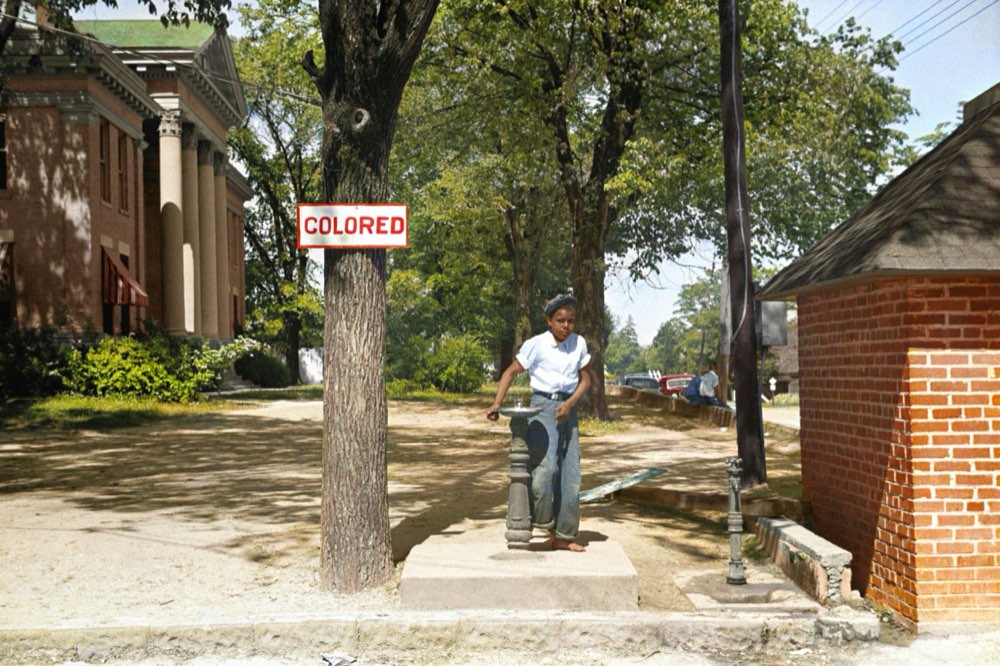
Imagine a restaurant with a sign on the door: No entry without a high school diploma.
You'd probably find it offensive. You might assume it's illegal. In most of the United States, it isn't.
American civil rights law protects people from discrimination on the basis of race, color, religion, national origin, sex, disability, and age, and, since the Supreme Court's 2020 decision in Bostock v. Clayton County, sexual orientation and gender identity in employment. Those protections were won through generations of struggle, and they matter enormously.
Educational attainment is not on the list. No federal statute names it. With a few local exceptions (Washington, D.C.'s Human Rights Act, for example, protects "matriculation"), you can turn people away, pay them less, or refuse to rent to them because they never finished high school or never earned a college degree. The law has nothing to say about it, unless the policy happens to work as a stand-in for discrimination against a group that is protected.
That restaurant is a thought experiment. But the logic behind it isn't. It runs through American hiring, housing, marriage, politics, and public health. We call it educational apartheid: a caste system that is invisible, mostly legal, and very real.
The Prejudice Nobody Has to Hide
The philosopher Michael Sandel calls credentialism "the last acceptable prejudice." The research backs him up.
In a 2018 study in the Journal of Experimental Social Psychology, Toon Kuppens and colleagues measured how highly educated people in the U.S., U.K., the Netherlands, and Belgium viewed various disadvantaged groups. Their participants held more negative attitudes toward less-educated people than toward other stigmatized groups such as the poor or the obese. And unlike most other biases, they didn't feel any need to hide it. Participants tended to see low education as a personal failing, something people chose and therefore deserved.
That's what makes the prejudice so durable. Racism and sexism have become socially unacceptable for most people in professional life. Looking down on someone without a degree is often treated as simple realism.
How a Credential Becomes a Caste
Apartheid isn't one law. It's a set of sorting mechanisms that, taken together, decide where people can work, live, and belong. Educational sorting in America works the same way.
Work. The most consequential gate is the job posting. A 2017 Harvard Business School and Burning Glass study, Dismissed by Degrees, found that 67% of production supervisor job postings required a bachelor's degree, while only 16% of the people already doing that job had one. The nonprofit Opportunity@Work counts more than 70 million American workers who are skilled through alternative routes (trades, community college, military service, on-the-job training) yet are routinely screened out by what they call the "paper ceiling."
The law came close to dealing with this once. In Griggs v. Duke Power Co. (1971), the Supreme Court struck down a high school diploma requirement because it shut out Black workers at far higher rates and the company couldn't show the diploma had anything to do with the job. Look at what that ruling did, though: it protected people from degree requirements only when those requirements acted as a proxy for racial discrimination. The diploma requirement itself, used against people simply for lacking a diploma, stayed perfectly legal.
Place. Americans increasingly live in neighborhoods sorted by education. College-educated professionals cluster in high-cost metros and particular zip codes, and zoning, housing costs, and school-district boundaries keep the lines firm. Where you live decides which schools your children attend, which closes the loop for the next generation.
Family. Americans increasingly marry within their education level. Economists call this assortative mating, and it concentrates income, wealth, and educational advantage inside the same households, generation after generation.
Voice. Education is now one of the strongest predictors of how Americans vote, and among the most important predictors of whose views shape policy, media, and the institutions that write the rules. The people writing job descriptions, admissions criteria, and zoning codes mostly sit on one side of the line.
Life itself. Economists Anne Case and Angus Deaton have documented a widening gap in life expectancy between Americans with and without a four-year degree. By 2021, the gap in expected adult lifespan between the two groups had grown to roughly eight and a half years. Their research on "deaths of despair" (from drugs, alcohol, and suicide) found these deaths concentrated overwhelmingly among adults without a bachelor's degree.
Put these together and you get a country divided roughly in two. About 38% of American adults over 25 hold a bachelor's degree. The other 62% live on the other side of an invisible wall that shapes their wages, their neighborhoods, their health, and how much respect they get.
Why "Just Get a Degree" Isn't an Answer
The usual response is that the wall has a door. Anyone can go to college.
In practice, the door is narrow, expensive, and badly designed. Tuition has risen far faster than inflation for decades. Students carry debt that follows them for years. And many people who start college never finish. They leave with debt and no credential, which is the worst outcome possible.
The deeper problem is how college is built. As we've written before, most universities still teach the way they did in 1950: a lecture, a textbook, a final exam, and a fixed calendar that moves on whether or not you've learned the material. That model works reasonably well for students who arrive already well prepared, with free time, family support, and no job or children to look after. It works much worse for everyone else.
So the gate rewards people who were already advantaged, charges a fortune to those who try to get through it, and fails many of them anyway. Then society treats the outcome as a measure of personal merit.
What Elton Is Built to Do
Elton University exists to dissolve this caste system. We go after the two things that keep the door narrow: education that doesn't work well enough, and costs that are far higher than they need to be.
We use the cutting edge of learning science. We know a great deal about how humans learn, and most of it is ignored. Benjamin Bloom found in 1984 that students given one-on-one tutoring performed two standard deviations better than students in conventional classrooms, meaning the average tutored student outperformed 98% of the comparison group. Decades of cognitive science since then have confirmed the power of retrieval practice, spaced repetition, interleaving, and mastery-based progression. Elton is built on these findings: one-on-one work with expert faculty and coaches, advancement when you've actually mastered the material, and credit for what you already know.
These methods matter most for the students the current system fails. A lecture hall rewards students who already know how to learn from a lecture. A tutor meets you where you are.
We automate the bureaucracy. Administrative overhead is one of the biggest reasons college costs so much. At many universities, administrators and staff far outnumber the faculty doing the teaching. Elton uses modern software and AI to automate the paperwork, scheduling, compliance reporting, and back-office work that legacy institutions staff with large departments. Every dollar we don't spend on administration goes to the thing that actually changes lives: time with great teachers.
We price for access, not prestige. Elton is a 501(c)3 nonprofit. Our tuition is comparable to or lower than public universities, and the large majority of our students receive financial aid. We have no interest in exclusivity. A university that brags about how many people it turns away is advertising its part in the caste system.
The Future We're Working Toward
We don't think the answer to educational apartheid is a world where everyone holds the same piece of paper. We want two things at once.
First, a dignified life for everyone, regardless of credentials. Nobody's health, housing, safety, or basic respect should depend on whether they finished a degree. A society that lets life expectancy split along educational lines has confused a credential with a person's worth. Electricians, caregivers, farmers, artists, and line cooks deserve the same dignity as lawyers and engineers, and the same chance at a long, secure life.
Second, education that's excellent, exciting, and open to anyone who wants it. Learning isn't a sorting machine. At its best, it is one of the most meaningful experiences a person can have: the excitement of understanding something hard, the confidence of mastering a skill, the freedom of being able to think for yourself. That experience shouldn't be rationed by price, geography, or a teenager's high school transcript. It should be available at 19, 35, or 60, to anyone curious enough to pursue it.
When both of those things are true, educational attainment stops working as a wall. It becomes what it should have been from the start: a personal path people choose because learning is worth doing, not a ticket into a protected class of citizens.
The restaurant sign doesn't need to be banned. It needs to become unthinkable.
If you want an education built around how people actually learn, apply to Elton. If you believe high-quality education should belong to everyone, support our mission.
Elton University is a 501(c)3 nonprofit organization (EIN 86-2426898) based in San Francisco, CA.
Sources
- Bostock v. Clayton County, 590 U.S. 644 (2020).
- Griggs v. Duke Power Co., 401 U.S. 424 (1971).
- Civil Rights Act of 1964, Titles II and VII; Americans with Disabilities Act (1990); Age Discrimination in Employment Act (1967).
- District of Columbia Human Rights Act of 1977, D.C. Code § 2-1401.01.
- Sandel, M.J. (2020). The Tyranny of Merit: What's Become of the Common Good? Farrar, Straus and Giroux.
- Kuppens, T., Spears, R., Manstead, A.S.R., Spruyt, B., & Easterbrook, M.J. (2018). "Educationism and the irony of meritocracy: Negative attitudes of higher educated people towards the less educated." Journal of Experimental Social Psychology, 76, 429–447.
- Fuller, J.B., & Raman, M. (2017). Dismissed by Degrees: How Degree Inflation Is Undermining U.S. Competitiveness and Hurting America's Middle Class. Accenture, Grads of Life, and Harvard Business School.
- Opportunity@Work. "Tear the Paper Ceiling" research on STARs (workers Skilled Through Alternative Routes).
- Case, A., & Deaton, A. (2020). Deaths of Despair and the Future of Capitalism. Princeton University Press.
- Case, A., & Deaton, A. (2023). "Mortality rates by college degree before and during COVID-19." PNAS, 120(31).
- U.S. Census Bureau. Educational Attainment in the United States, Current Population Survey.
- Bloom, B.S. (1984). "The 2 Sigma Problem: The Search for Methods of Group Instruction as Effective as One-to-One Tutoring." Educational Researcher, 13(6), 4–16.