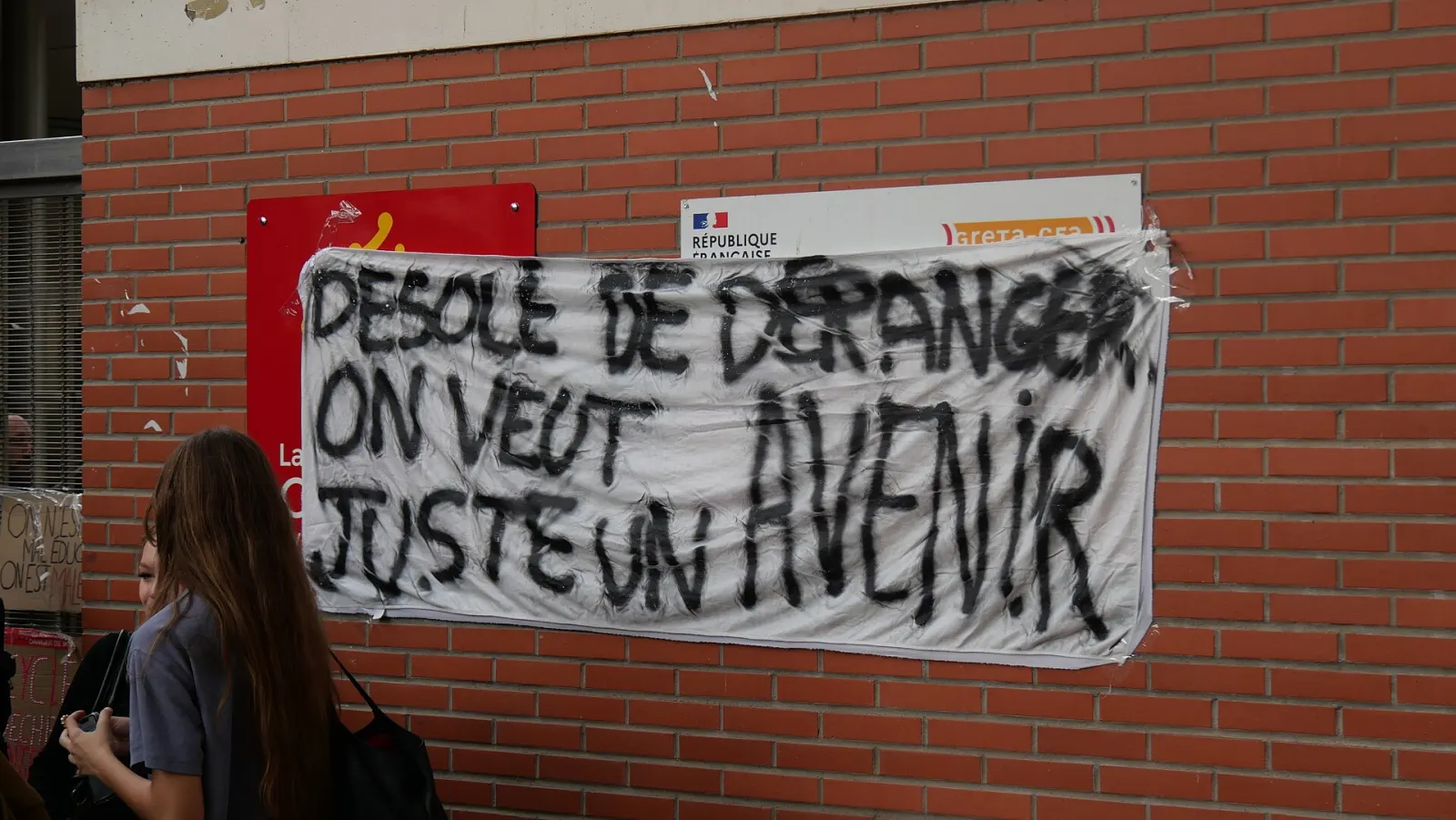
"Désolé de déranger, on veut juste un avenir." Sorry to bother you, we just want a future. A banner outside a lycée in Perpignan, 2 October 2026. Photo: Aurelio Cárdenas, CC BY 4.0, resized.

On 18 September 2026, students at the Lycée Antoine-de-Saint-Exupéry in Créteil blocked their school gates. Within two weeks more than a thousand lycées across France had been disrupted. On 6 October, somewhere between 250,000 people (the government's count) and 450,000 (the unions' count) marched together: students, teachers, parents. University students joined them, and the movement spread to Belgium, Albania and Greece.
The response has been harsh. More than 6,100 people have been taken into custody, most of them minors. Teenagers have been seriously hurt. Officials have blamed far-left agitators.
Look at what the students are actually asking for, though, and it isn't radical. They want a teacher in front of the class. They want a chair to sit on. They want toilets with running water and classrooms below 35°C. They want a timetable they can survive and a university admissions process (Parcoursup) that doesn't take over their adolescence.
"We are 35 per class, we don't have enough chairs." (A French lycéen, quoted by Reuters)
"Seven months without a French teacher, in a year with a French exam." (A student describing their school year)
These aren't ideological demands. They're the sort of thing education research has been measuring for fifty years, and the research mostly agrees with the students. There's also a country two hours' flight from Paris that has been running its schools on that research for a generation: Finland.
What the Data Says About French Schools
The students aren't exaggerating. By the standard international measures, French secondary education is under real strain:
- Lost teaching. Nearly 10% of teaching hours in French public secondary schools went untaught in 2024–25. About 7.5 percentage points of that was because no substitute could be found.
- Crowded classes. French lower-secondary classes average 26 pupils, against an OECD average of 23 (OECD, 2025). In lycées, classes of 32 to 36 are routine.
- Long days. French pupils sit through 864 hours of compulsory instruction a year in primary school and 973 in lower secondary, both well above the OECD averages of 804 and 909.
- Teachers leaving. Teacher resignations rose roughly sevenfold between 2008 and 2022. In 2024, 3,076 teaching posts went unfilled after the national recruitment exams, and some CAPES subjects drew fewer than one candidate per post. The reasons teachers give are low pay, little recognition, and a loss of professional freedom under new baccalauréat programs.
- Falling results. France's PISA maths score dropped 21 points between 2018 and 2022, the steepest fall since PISA began. The share of 15-year-olds struggling in maths went from 22% in 2012 to 29%.
Each of these feeds the others. Teachers quit, so classes are merged and grow. Bigger classes and longer days wear out the teachers who stay. Then more hours go untaught, results fall, and students hit Parcoursup feeling unprepared and anxious. Being unable to see a way out of that loop is what "on veut juste un avenir" is about.
What Finland Does Differently
Finland is often called a model of evidence-based education: a research-informed system run by highly trained professionals rather than by tradition or political fashion. Compare it with France on the students' own grievances:
| France | Finland | |
|---|---|---|
| Compulsory instruction hours / year (primary) | 864 | 660 |
| Compulsory instruction hours / year (lower secondary) | 973 | 817 |
| Average lower-secondary class size | 26 | under 20 |
| Teacher qualification | Master's degree + national exam | Research-based master's degree from a highly selective program |
| PISA 2022 maths / reading / science | 474 / 474 / 487 | 484 / 490 / 511 |
| Public spending on education (% of GDP) | 5.1% | 6.3% |
Sources: OECD Education at a Glance 2025; OECD PISA 2022; Eurostat via Al Jazeera, 2026.
Shorter days, more learning per hour
Finnish children spend about 200 fewer hours a year in class than French children at primary level and about 150 fewer in lower secondary. Finnish lessons are typically 45 minutes long and are followed by a break of about 15 minutes, often outdoors.
This is a choice backed by research, not a relaxed attitude to learning. Across OECD countries, total instruction time is only weakly linked to PISA results: what matters is what happens in each hour. Attention runs down over a long day. A study of two million Danish test results found that students scored worse the later in the day they were tested, and that a 20–30 minute break restored performance (Sievertsen, Gino & Piovesan, PNAS, 2016). Studies of recess point the same way: children pay more attention after unstructured breaks (Pellegrini & Bohn, 2005).
The French timetable that students call "overloaded" is long, but the length isn't buying much.
Smaller classes, especially for students who need them most
Class size is one of the best-studied questions in education. In Tennessee's Project STAR, a large randomized trial, students placed in classes of 13–17 outperformed those in classes of 22–25 by about 0.2 standard deviations. The gains were roughly double for low-income and minority students (Krueger, 1999).
The best evidence for France comes from France. Thomas Piketty and Mathieu Valdenaire studied French écoles, collèges and lycées and found that smaller classes raised achievement, with the largest benefits in disadvantaged schools. Targeted class-size cuts could close a meaningful share of the gap between priority-education (ZEP) schools and the rest (Piketty & Valdenaire, 2006). France already acted on this once: since 2017 it has halved CP and CE1 classes in its most disadvantaged schools. Students in Créteil are asking for the same principle to be applied after age seven.
Teachers who stay
Finland's most important policy may be how it treats teachers. Every teacher holds a research-based master's degree, and places in teacher education have historically gone to around one applicant in ten, making entry about as competitive as medicine or law. Once qualified, Finnish teachers get wide professional autonomy. There are no school inspectors grading their lessons and no national ranking tests pushing them to teach to the test. Researchers attribute Finland's comparatively low teacher attrition to that combination of status, trust, autonomy and time to collaborate.
French teachers leaving the profession cite the opposite: little recognition and less and less freedom over how they teach. An evidence-based system recruits professionals and then trusts them. France's resignation figures suggest it has been doing the reverse.
Feedback instead of fear
Finnish schools rely on formative assessment: frequent, low-stakes feedback that tells a student where they stand and what to do next. Students sit no high-stakes national exam until the matriculation examination at the end of upper secondary. Black and Wiliam's landmark review found that strengthening formative assessment produced learning gains of roughly 0.4 to 0.7 standard deviations, among the largest of any educational intervention (Black & Wiliam, 1998). It costs little and lowers anxiety, which is the other half of the Parcoursup complaint.
Is Finland Affordable?
Finland's model is not cheap. Finland spends 6.3% of GDP on education against France's 5.1%, and spends far more per lower-secondary student. Anyone who says France can copy Finland for free is selling something.
Two points still matter.
First, much of the evidence-based agenda costs very little. Shorter lessons with real breaks, formative feedback in place of high-stakes ranking, and more professional autonomy for teachers are changes of design, not of budget. Shorter instruction hours actually reduce the teacher-hours each pupil requires.
Second, France is already paying for the status quo. It pays when one hour in ten goes untaught, when substitutes have to be rushed in (3,000 by mid-October), when thousands of trained teachers resign, and when 400 schools close during a crisis. It pays again when a generation's maths scores fall. The question isn't whether France can afford evidence-based schools. It's whether France can keep paying for the system it has.
And Finland is not a fairy tale. Its PISA scores have fallen steadily since 2006. Budget cuts have merged schools, enlarged classes and reduced teacher training, and the gap between rich and poor students has widened. That's a warning in itself: when Finland moved away from its own evidence-based commitments to small classes, well-supported teachers and equity, its results declined.
An Evidence-Based Settlement
If France's leaders want to end this crisis with a lasting settlement rather than tear gas, the research points to a short list of measures:
- Cap lycée classes and extend the CP/CE1 class-halving logic to secondary schools in priority-education areas, where the evidence says the return is highest.
- Make teaching an elite, trusted profession, with higher pay, research-based preparation and real classroom autonomy, so posts stop going unfilled and teachers stop leaving.
- Shorten the timetable and build in real breaks, so each hour of instruction counts.
- Shift from ranking to feedback, using formative assessment through the school years and lowering the stakes of Parcoursup.
- Fix the buildings. No intervention works in a classroom at 35°C with no chairs.
None of this is utopian. Every item has been tested, much of it in France itself. The students asking for it aren't asking the state to do something new. They're asking it to do what the evidence already shows works.
Why This Matters to Us
Elton University was founded on the idea behind this post: education should be built on what research shows about how people learn, not on habit. The ultimate small class is a class of one. Benjamin Bloom found that students taught one-on-one outperformed 98% of their peers in conventional classrooms. That is the model Elton is built around.
The lycéens of Créteil, Perpignan and Paris are asking a fair question: why do schools ignore what we know works? We think they deserve a good answer, and so does every student.
Interested in an education designed around the evidence? Schedule a free information session or apply now. Elton University is a 501(c)3 nonprofit, EIN 86-2426898.
Sources
- Wikipedia (2026). 2026 French student protests.
- TIME (2026, October 2). Why are students protesting across France?
- The Washington Post (2026, October 6). Protests sweep France, closing schools as student walkouts escalate.
- CNN (2026, October 7). French students say they're just getting started.
- Al Jazeera (2026, October 8). How much does France spend on education compared with the rest of Europe?
- OECD (2025). Education at a Glance 2025: country notes for France and Finland; indicators on instruction time and class size.
- OECD (2023). PISA 2022 Results: country notes.
- Acteurs publics (2024). 7,5 fois plus de départs volontaires d'enseignants en dix ans.
- Assemblée nationale (2025). Proposition de loi n° 1715 (teacher resignations and unfilled posts).
- Finnish Government (2023). PISA 2022: Performance fell both in Finland and in nearly all other OECD countries.
- AQA (2025). Finland & PISA: A fall from grace but still a high performer?
- Black, P. & Wiliam, D. (1998). Assessment and classroom learning. Assessment in Education, 5(1), 7–74.
- Krueger, A.B. (1999). Experimental estimates of education production functions. Quarterly Journal of Economics, 114(2), 497–532.
- Pellegrini, A.D. & Bohn, C.M. (2005). The role of recess in children's cognitive performance and school adjustment. Educational Researcher, 34(1), 13–19.
- Piketty, T. & Valdenaire, M. (2006). L'impact de la taille des classes sur la réussite scolaire dans les écoles, collèges et lycées français. Ministère de l'Éducation nationale, Les Dossiers n° 173.
- Sievertsen, H.H., Gino, F. & Piovesan, M. (2016). Cognitive fatigue influences students' performance on standardized tests. PNAS, 113(10), 2621–2624.